Interoception: How I Feel (2018) Cara Koscinski

Interoception is a key topic for resilience. In the Community Resiliency Model and beyond, many models of wellness and self care rely on the ability to sense what is happening on the inside of our bodies. If we can't identify and notice sensations of distress, tightness, or pain, we are missing a key element of feedback in the system. This book claims it has all you need to learn about and practice building interoception.
I’m glad there are many newer books widely available on this topic. This book is poorly organized and in dire need of a more helpful editor. The author clearly has tons of experience and knowledge regarding the topic, but it appears haphazardly throughout the book. The more academic sections of the book are poorly written, with whole pages that are just unexplained quotes from sources. If this were one of my student’s dissertation, I would send it back.
One of the resilience questions from the Community Resiliency Model is to ask, “what else is true?” So I won’t ignore the fact that this book is so poorly written. But I will say there’s a reason I stuck with it, and here I share some of the goods.
There are a lot of interoception-building exercises. One of them is “sensory breathing,” in which children are asked to make a tissue “dance” by blowing out through the nose. This also includes bee-breathing, where exhalation is a bzzzzzz. In My Grandmother's Hands, Resmaa Menakem shares a similar exercise. Another is mindful eating. The idea is to provide a list of adjectives related to foods and a visual with different items your child eats. This could be a cognitive exercise, but if it's done at the table, it can be made experiential.
There are helpful tips and scaffolds for kids, such as a step by step way to take heart rate, and for adults who might not know the best ways to address children. One phrase the author shares is, “Life is not fair, I agree. So let’s figure out together how we can tackle this problem.” This phrase validates the child and doesn’t leave it at that.
One of the obvious but helpful tips is to never tell a child to calm down. (Never tell anyone to calm down). It doesn’t work. If it does “work,” it just makes a person go silent with resentment.
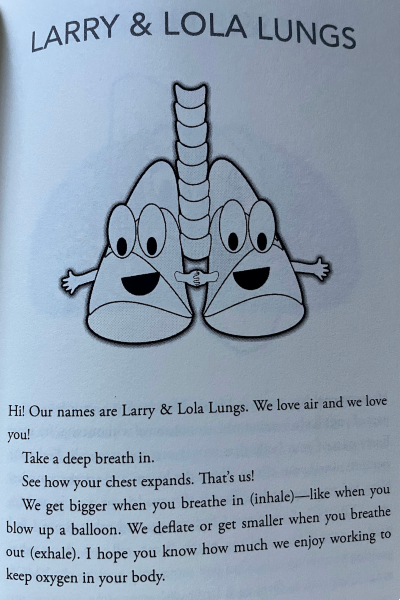
Probably the best part of the book, perhaps its core, perhaps the only reason it deserves the title interoception, and perhaps the best connection to building resilience: her drawings and names for body parts. She's got Billy Bone, Larry and Lola Lungs, Lub Dub Heart, and many other key internal organs labeled in a kid-friendly way. These visuals and short explanations, in combination with "body scan" activities, can plant cognitive seeds for the beginnings of interoceptive awareness.

So…don’t buy this book. It’s been around since 2018 and most of the best activities can probably be found with a Google search. I don’t know which new book is best for learning what is known about interoception, but I would guess any of them are better than this one.